1 min read
CyberTowns - Which are the best cyber towns in Canada to work?
 Canadian Cybersecurity Network News : Oct 31, 2023, 8:28:46 AM
3 min read
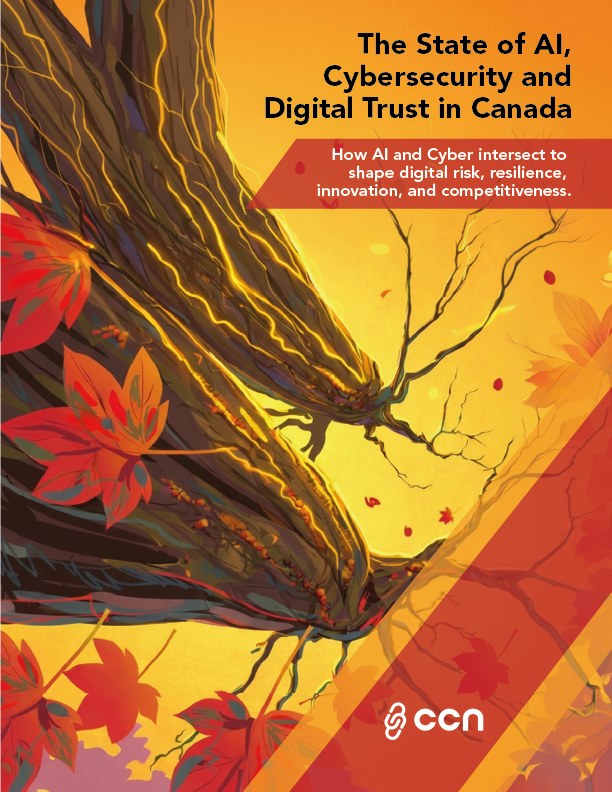

Artificial intelligence (AI) is moving rapidly from experimentation into the operational core of the economy. Systems that once analyzed information are now guiding decisions, executing tasks and interacting with other digital systems with minimal human oversight. This shift is transforming not only how businesses operate but also how they must think about security, governance and risk.
A new national report released this week by the Canadian Cybersecurity Network, The State of AI, Cybersecurity and Digital Trust in Canada, argues that the convergence of AI and cybersecurity will be one of the defining business challenges of the next decade. Launched at the NGen Advanced Manufacturing Conference in Toronto, the report makes clear that AI is reshaping the threat landscape on both sides of the equation, fueling faster, more adaptive cyber attacks while also emerging as one of the most potent defensive technologies organizations have ever had at their disposal
AI Is Accelerating the Threat Landscape
Across sectors, organizations are embedding AI into products, workflows and decision making at unprecedented speed. At the same time, cybercriminals are using the same technology to increase the speed and sophistication of their attacks.
Generative AI can now produce convincing phishing campaigns, automate reconnaissance and even create deepfake impersonations of executives or employees. In many cases the tactics themselves are not new. What has changed is the speed, scale and realism of the attacks.
Global incident data examined in the report shows that synthetic text used in malicious emails has doubled in recent years. Cybercriminal groups are also beginning to use large language models to support malware development, vulnerability discovery and increasingly sophisticated fraud campaigns.
AI Is Also Transforming Cyber Defense
Yet the rise of AI driven cyber threats tells only half the story.
AI is also rewriting the defensive playbook. Security operations teams are turning to AI to cut through the noise of endless alerts, spot anomalies across complex environments and drive investigations at speeds that were previously impossible. Early adopters report dramatically shorter detection and containment times, along with significant reductions in breach costs. The result, a cybersecurity landscape where both attackers and defenders are now operating at dramatically higher speed
“Artificial intelligence is rapidly transforming the foundations of the digital economy,” says François Guay, founder and chief executive of the Canadian Cybersecurity Network. “The question is no longer whether AI will change cybersecurity. It already has. The real challenge now is whether organizations can govern these systems safely and responsibly.”
The Leadership Shift
The report argues that the real disruption created by AI is organizational, not just technological. For most of the digital era, executives focused on managing technology assets, namely software, networks and data, while security programs were built to protect systems and respond to incidents. AI breaks that model. Companies are now deploying systems capable of reasoning, planning and executing decisions inside core business operations.
As a result, leadership is transitioning from managing technology to governing machine‑driven decision systems. And that shift carries profound implications for boards and executives, as governance, oversight and accountability must now extend to autonomous systems that operate continuously and often faster than traditional human decision processes
Cyber Maturity as a Business Requirement
One of the report’s central findings is that cybersecurity is becoming closely tied to economic competitiveness.
Enterprises, insurers, regulators and supply‑chain partners increasingly require organizations to demonstrate credible cybersecurity practices before allowing them to connect systems, exchange data or participate in critical operations. Companies that cannot demonstrate strong governance may find themselves excluded from contracts, partnerships or even insurance coverage.
In this environment, cyber maturity is rapidly becoming a passport to participate in the digital economy.
“Organizations that can demonstrate strong governance and secure use of AI will be better positioned to innovate, collaborate and compete globally,” Guay says.”
A New Attack Surface
AI is also expanding the attack surface itself.
Traditional cybersecurity focused on protecting networks, endpoints and software. AI adds a new layer of risk tied to prompts, data pipelines, automated workflows and the behaviour of intelligent systems; this leads to attack surfaces that barely existed a decade ago. At the same time, automated services, bots, APIs and AI agents are spreading across enterprise environments, and in many organizations these machine identities now outnumber human users. This creates growing challenges around access control and security oversight as companies try to protect systems increasingly populated by autonomous technologies.
Trust as Infrastructure
Taken together, these changes point to a deeper economic shift. Cybersecurity is evolving from a technical discipline into a strategic foundation for economic participation, and organizations must now demonstrate that their systems are secure, their governance structures are credible and their digital operations are resilient.
In other words, trust is becoming infrastructure.
For Canada, the report argues, this transformation presents both risk and opportunity. The country has a globally recognized AI research ecosystem and a strong cybersecurity talent base supported by universities, industry and government collaboration, but as AI adoption accelerates across sectors, the nation’s digital attack surface is expanding just as quickly.
Bridging the gap between innovation and governance will require coordinated action between industry, policymakers and the cybersecurity community.
AI will reshape industries in the coming decade, yet its long‑term success will not be determined solely by computing power or model sophistication. It will depend on whether organizations can build and maintain the trust required to operate these systems safely.
In the emerging digital economy, competitive advantage will not belong only to those who innovate the fastest. It will belong to those who govern technology the best
You can reach the Canadian Cybersecurity Network here. Download the report here.

1 min read
Canadian Cybersecurity Network News : Oct 31, 2023, 8:28:46 AM

1 min read
Canadian Cybersecurity Network News : Oct 16, 2024, 6:40:04 AM
The Canadian Cybersecurity Network (CCN) proudly launched CCN Connect, a new Discord platform designed to foster networking, collaboration, and...
1 min read
Canadian Cybersecurity Network News : Jan 28, 2026, 9:21:09 AM
PRESS RELEASE Canadian Cybersecurity Network Releases State of Cybersecurity in Canada 2026, Warning That Digital Trust Is Now...